Friday, November 14, 2008

San Jose High-Rises Keep Sales Up in Santa Clara County

If you haven't checked out this article from a few days ago, published in Mercury News, you really should--it bears good news for buyers, sellers, and people just interested in an indicator from the real estate front about how the economy is going downtown San Jose. While new home sales in September were pretty dismal throughout California, one pocket in Santa Clara showed an opposite trend.  In downtown San Jose and parts of Palo Alto new condo sales were up nearly 150% from the previous year. 

Some of the condos were high-rise, expensive properties, and almost all of them attracted a specific kind of buyer--tech workers, empty nesters, people who'd been renting downtown for a while. There's an interesting question lurking behind this boom in condo sales--since the burst of the housing bubble, are condos in prime downtown areas simply a safer investment? Do people feel more comfortable purchasing condos over houses these days, or is this a matter of coincidence? What do you think?

Bay Area Highlights, Thru Nov 23

Bay Area Highlights
The Peninsula and South Bay Edition: Check out these great events!

Music--
Palo Alto Philharmonic Chamber, 8:00PM, 11/15
Schubert's Trout Quintet. Tickets www.paphil.org
Classical Art Center Auditorium, Palo Alto

The Namedroppers starring Eddie Money plus Moreality, 8:00PM, 11/12
Fox Theatre, Redwood

Celine Dion, 7:30PM, 11/23
Pop HP Pavilion, San Jose

Brazilian Jazz Showcase With Ed Johnson & Novo Tempo, 4:00PM, 11/23
City Lights Theater, San Jose

Things To Do: 
Project Runway Finalist Daniel Vosovic, 11/7, 7:30PM
Daniel Vosovic discusses and signs Fashion Inside Out: Daniel V's Guide to How Style Happens From Inspiration to Runway and Beyond.
Kepler's, Menlo Park

The Peninsula French Fair, A Day in France, 11/8, 10:00AM--6:00PM
Original French products--start your Christmas shopping!
Hillview Community Center, Los Altos 

2008 San Mateo Harvest Festival, 11/14-11/16, 10:00AM--6:00PM
San Mateo County Event Center, San Mateo


Brought to you by Cindy Solomon, North American Title Company

Tuesday, November 11, 2008

Hope Now Alliance: Lifeline or Deadweight?

The recently created Hope Now Alliance seems like exactly what this country needs--a coalition of banks and government agencies working together to help people facing foreclosure stay in their homes.

Some banks, like Citibank, intend to work hand in hand with borrowers to settle on a mortgage borrowers can handle--Citibank has also vowed not to start foreclosure proceedings on anyone who has enough income to handle a reasonable mortgage. Statistical evidence seems to show that these attempts are working--drops in foreclosures are seen in CA. Even so, foreclosures in the last two years are unprecedented, and foreclosures are always bad news for the economy--they serve to bring down housing values, therefore spawning more foreclosures. 

The plan behind the program is to quicken the pace on the mortgage modification process so that mortgages become more affordable soon enough to save some people in critical danger of foreclosing. The plan also solidifies loan modification rules, and many companies have added staff to help handle the surge of cries for help. 

But the question still remains--will modified mortgages be low enough that people will be able to make their payments? Many people are doubtful that the new plan will actually be able to help them. Plus, a borrower can't get help until they're past due, even if they're having trouble keeping their head above water. Some people fear the banks encourage people to get past due before throwing them a lifesaver. 

Check out the full text article of this story in Mercury News, called Sweeping Mortgage Aid Plan Unveiled. It's written by Pete Carey and contains loads more details about the new plan and what it means for borrowers. 

Thursday, November 6, 2008

C.A.R Market Matters, November 6

Thursday November 06, 2008
Brought to you by the CALIFORNIA ASSOCIATION OF REALTORS

C.A.R's Mortgage Update

This week C.A.R is introducing an occasional new feature in Market Matters entitled Mortgage Update. Mortgage Update will update REALTORS and consumers on recent news about the mortgage market. 

This issue of Mortgage Update contains news and updates on the "Hope for Homeowners" program, and foreclosure assistance programs for borrowers with mortgages issued through Indymac, JP Morgan Chase and Co, and Countrywide.

MAKING SENSE OF THE STORY FOR CONSUMERS

Early projections indicate that only 20,000 troubled homeowners will apply for the "Hope for Homeowners" program, a considerable reduction from the previously estimated 400,000 homeowners who were expected to apply. The $300 billion program was launched Oct. 1 and is designed to help troubled homeowners rewrite a "risky" mortgage loan into a 30-yr, fixed-rate loan with a lower interest rate. During the first two weeks of the program, the Federal Housing Administration, which oversees Hope for Homeowners, reported receiving only 42 applications. Some housing experts believe the low application rate is due to the program being voluntary for lenders and provisions requiring homeowners to agree to an equity share with the government. 


Less than half of homeowners with mortgage loans through IndyMac have responded to offers from the Federal Deposit Insurance Corporation (FDIC) to lower loan payments and interest rates. The FDIC, which is running IndyMac, mailed 35,000 letters offering homeowners an opportunity to rework the terms of their mortgages. The goal is to reduce the monthly payment on a loan, including taxes and insurance, to no more than 38% of the borrower's pretax income. The FDIC is prepared to implement the following: reduce the interest rate to as low as 3%; extend a loan's terms to 40 years; and waive interest on a portion of the mortgage balance.


JPMorgan Chase % Co has reported that it is instituting a 90-day foreclosure freeze while it searches for ways to make payments easier for consumers. The program may enable up to 400,000 borrowers to reduce their interest rates or principal amounts. The bank will also open 24 mortgage counseling centers in areas with the highest delinquency rates. JPMorgan also is planning to hire 300 loan counselors to work with delinquent borrowers and employ approximately 150 additional staffers to review each mortgage prior to sending it through the foreclosure process. The program offer is extended to borrowers who have loans through Washington Mutual Inc., and clients of EMC, a mortgage unit of Bear Sterns Companies. Both companies were acquired by JPMorgan in recent buyouts and takeovers.


Bank of America, which acquired Countrywide in July, said that nearly 400,000 troubled homeowners who have subprime mortgages and option adjustable-rate loans through Countrywide may be eligible for loan modifications. To be eligible for the Bank of America plan, homeowners must occupy the home as their primary residence, the mortgage must be seriously delinquent---or likely to become so; and the loan must have been serviced by Countrywide and originated prior to December 31, 2007. Bank of America will help borrowers by restructuring first-year payments of principal, interest, taxes and insurance to no more than 34% of the borrower's income; halting foreclosure sales against borrowers who are likely to qualify for a loan modification; and waiving restructuring fees and prepayment penalties. 


 Chicago Tribune
Finding an area with appreciation potential
Some real estate experts believe that home buyers who purchase a house during the current market will gain equity if they stay in the house for at least five years and purchase in a desirable neighborhood.

MAKING SENSE OF THE STORY FOR CONSUMERS

Neighborhoods with strong employment bases, such as hospitals, universities, and government, tend to be recession-proof. People desire to live near their jobs, so housing that is in close proximity to these types of industries are generally higher in demand than those in other areas.

High gas prices and roadway congestion have led many people to see "walkable" communities--nieghborhoods that offer both daily needs such as grocery stores and coffee shops to more speciality items like hair salons, all within walking distance. Walkable communities also provide public transportation, which is becoming more desirable to many home buyers and is increasing demand for housing in these areas.  One web site, walkscore.com, calculates teh walkability of a community by locating stores, restaurants, schools, parks, and other attractions that are within walking distance. The scores are based on a 100-point scale with 100 points being a walker's paradise.

Home buyers who seek a new or nearly-new home should search in areas where the homebuilder is known for honoring warranties and building high-quality homes that are structurally sound. Homes in these areas are more likely to weather well and gain value in the future than homes in areas where the home builder is unknown.

Homes in neighborhoods with sales momentum generally appreciate at a faster pace than areas where sales are flat. Some real estate industry consultants advise clients to pay close attention to the "list to sale" numbers, which reflect the difference between the asking price and the final closing price. Usually if the gap in list-to-sale numbers is narrow, then the real estate market in that area is improving.


CNN MONEY
7.5 million homeowners "underwater" 
Approximately 7.5 million U.S homeowners owe more on their mortgages than their homes are currently worth, and an additional 2.1 million Americans own homes valued at only 5% more than their loan.

MAKING SENSE OF THE STORY FOR CONSUMERS

According to some estimates as many as 12 million borrowers may have negative equity in their home, meaning that they owe more on their mortgage loans than their homes are currently worth. However, according to statistics gathered by C.A.R over the last 40 years, homeowners who purchase a house and keep it for at least five years have an average annual rate of return at nearly 12%. 

Although California's inventory of homes with high negative equity is higher compared with other states, lower home prices have increased affordability, making it easier for first-time home buyers to enter the market and other buyers to move up to larger houses or more desirable neighborhoods.

Borrowers who are facing foreclosure should work with their lender and apply for a loan modification program. Many financial institution are offering homeowners the opportunity to rewrite an adjustable-rate mortgage into one that is fixed for 30 years. Some banks are also offering existing customers zero interest for a short period of time and lowering the principle balance on the loan to make payments more affordable.


Washington Post
Meltdown 101: How we'll know we're in a recession
Recent economic reports and many news stories have led some Americans to believe the country is in a recession. Although unemployment is high and incomes have failed to keep pace with inflation, the country is not yet in a recession, which must be declared by the National Bureau of Economic Research (NBER)

MAKING SENSE OF THE STORY FOR CONSUMERS

The National Bureau of Economic Research (NBER) is the entity that officially declares the country is in a recession. Founded in 1920, NBER consists of more than 1,000 university professors and researchers who study the economy. The Business Cycle Dating Committee within the NBER makes the call on recessions. Often times NBER doesn't declare a recession until after it's over.

Contrary to popular belief, a recession is not defined as two consecutive quarters of negative gross domestic product growth. NBER defines a recession as a significant decline in an economic activity spread across the economy, lasting more than a few months. This is usually based on reports such as the gross domestic product--a measure of the value of all goods and services produced within the United States; real income, employment, industrial protection, and wholesale and retail trade.

A recession's start and end dates are based on the high and low points within the nation's "business cycle" --periods of economic growth and contraction. A recession begins when the economy peaks at the top of an expansion period. It continues as the economy contracts until it hits the "trough", the lowest point on the downward cycle. After that, the economy begins to recover. The "peak" date is the beginning of the recession and the "trough" date is its end. The last official recession began in March 2001 and lasted eight months before ending in November 2001.


LA Times
'Green' improvements can add to a home's appeal
Many home buyers are seeking "green" homes to offset their carbon footprints and pocketbooks. Although most green homes are new houses, owners of existing homes for sale can make "green adjustments" to be more competitive in the market.

MAKING SENSE OF THE STORY FOR CONSUMERS

C.A.R recently launched a new Green website--"At Home with Green", which provides information to consumers and REALTORS about how to find and sell green homes; how to make green home improvements; and other tactics for greening their homes, offices, and lives. To visit, "At Home with Green" CLICK HERE

Consumers can work with their local utility company to conduct an energy audit to determine how green a home is and to get pointers on how to further green the home. Although the changes could be costly and the homeowner likely will not recoup all the money spent making the green upgrades, the home could sell faster with the improvements. Some home buyers may make an offer on the home as is, but might request a credit towards making the green improvements. Often times the credit will be nearly twice the amount that it would have cost had the homeowner made the improvements prior to listing the home.

Homeowners can make green improvements in their homes by making simple changes, such as replacing regular light bulbs with compact fluorescent bulbs (CFLS) which use only one-fifth the energy of regular bulbs and last almost 12 times longer, or more substantial improvements like replacing appliances with ENERGY STAR-rated ones, which can use as little as one-quarter the energy of older models.


In Other News...

CNBC

Wall Street Journal

Mercury News

Washington Post

LA Times

Talking Points
Here's what to tell consumers

The U.S Dept. of Housing and Urban Development (HUD) offers an online guide to preventing foreclosure. The guide provides consumers with information such as how to contact a housing counselor; when and how to talk to their lender, how to find foreclosure resources, tips on avoiding foreclosure and foreclosure scams, as well as information for consumers who cannot keep their home. The guide to preventing foreclosure can be accessed here. 


Wednesday, November 5, 2008

New Proposal Attempts to Stave Off Future Foreclosures

On Wednesday, Gov. Schwarzenegger made a proposal that will instate a 90-day freeze period for homeowners on the brink of foreclosure--basically, once a notice of default has been posted against them, their mortgages companies have to halt proceedings until they can prove that they have modified their loan processes to make it easier for people to stay in their homes. The goal is to inspire "aggressive modification programs" that will hopefully benefit both homeowners and lenders. The proposal still has to be passed by legislature.

Monday, November 3, 2008

Steve Papapietro's Weekly Mortgage Bulletin: Fed Cuts Again

For the week of Nov 03, 2008 --- Vol. 6, Issue 45

        Last Week in Review

        "TAKE TIME TO DELIBERATE; BUT WHEN THE TIME FOR ACTION ARRIVES...STOP THINKING AND GO IN." Napoleon Bonaparte. And taking action after deliberating was exactly what the Fed did last week, when they cut the Fed Funds Rate by .50%, lowering it to 1.00%.

Why did the Fed take action last week, after it had already lowered the Fed Funds Rate by .50% on October 8 in a coordinated effort with other central banks? To continue to help ease the credit crisis, and prevent a long and severe global recession. In fact, several foreign central banks followed the Fed's lead again last week, with Hong Kong cutting their lending rate by .50%, Taiwan cutting by .25%, and Japan cutting by .20%. This is important because cuts by other nations help stabilize the US Dollar, which typically loses ground after our Fed cuts rates, because of the lower yield offered comparatively offered in the US. Another interesting point to note: since oil is Dollar denominated, the price per barrel typically jumps after our Fed cuts rates, because of the decline in the value of the Dollar. The cuts by other central banks should keep oil...and gas prices, in turn...from skyrocketing again.

Another reason the Fed took action: The Fed's statement discounted threats of inflation, saying that slowing economic growth should lower inflation pressures over time, but added that downside risks to economic growth remain. And last week's negative Gross Domestic Product reading is confirmation that things have slowed quite a bit. Although experts have speculated that the US may already be in a recession, the first hardcore signs appeared when the Third Quarter Advance GDP report showed that consumer spending declined at the fastest pace in 28 years. The report also reflected the largest quarterly decline since the end of the last recession in 2001.

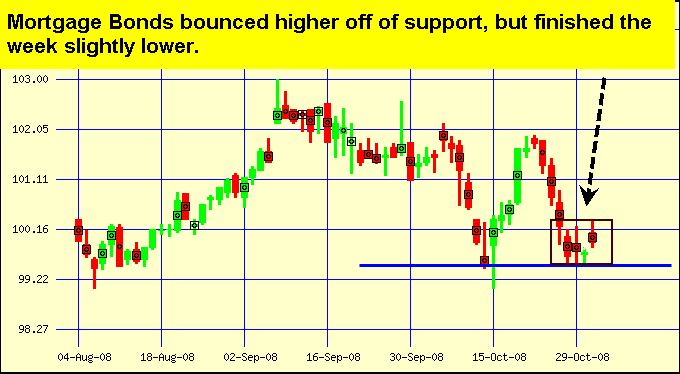
So what did all of this mean for Bonds and home loan rates last week? After worsening early in the week, Bonds and home loan rates attempted to stabilize by week end. And while it was a treat that Bonds did bounce off an important level of technical support, home loan rates still ended the week nearly .125-.25% worse than where they began.

SPECIAL NOTE: BRAND NEW VIDEO FEATURE IN THIS WEEK'S MORTGAGE MARKET VIEW! CHECK IT OUT TO LEARN SOME HOT TIPS TO CONSIDER WHEN BUYING OR LEASING YOUR NEXT VEHICLE.

        Forecast for the Week

        The excitement continues, as the heavyweight Jobs Report is scheduled for release this Friday, which will show the number of jobs lost or gained in October. Remember that the Department of Labor averages their numbers, and part of each month's report includes "revisions" to the several prior months' numbers. Last month, the Labor Department reported that 159,000 jobs were lost in September, which was worse than the 105,000 lost jobs that economists were expecting. As of last month's report, the US has lost 760,000 jobs so far in 2008. And the news for October is not expected to be any better.

A negative report could be bad news for Stocks and good news for Bonds and Home loan rates, as bad economic news typically causes money to flow from Stocks and into Bonds. But as has been noted in recent weeks, things are anything but typical at the moment. Bottom line: count on me to be watching closely to see how the markets react to this report and all the other news of the week...and feel free to call me anytime, even if you'd just like to do a quick review of your own current financial and credit situation.

As you can see in the chart below, Bonds did bounce off a key technical support level late in the week. I will let you know if Bonds can remain above this important support during the week ahead.

Chart: Fannie Mae 6.0%% Mortgage Bond (Friday Oct 31, 2008)

 Japanese Candlestick

Chart<http://www.mmgweekly.com/templates/mmgweekly/reg_chart/166/images/

fnma11308.gif>

        The Mortgage Market View...

        Click Here to view the latest Video.

<http://www.mmgweekly.com/w/index.html?SID=978362ce7b096266e2cefb878aa32

50b#view>

Should You Buy or Lease?

By Mark K. Solheim


To hear the critics wail, you'd think leasing a car is as bad for your finances as smoking cigarettes is for your health. Does that mean you're a closet wastrel if you've ever been tempted by ads that trumpet affordable monthly payments for a new car? Or, worse, that you are hurtling down the highway to financial ruin if you've already given in?

Relax. Leasing is not a mortal sin of money management. For some drivers, in fact, it makes sound fiscal sense. Leasing's not for everyone, but there's no reason to scorn the 15% of our fellow travelers who choose leasing over buying.

A Closer Look

Leasing often gets a bum rap because the lingo can make your head spin. It's difficult to compare one lease with another, not to mention to compare leasing with buying. And it can be tough to get a handle on leasing because the decision to lease or buy often depends on your mindset. "A lot of people are freaked out by having to turn in their car at the end of the lease," says Phil Reed, author of Edmunds.com's Strategies for Smart Car Buyers. "What they fail to realize is that they got the first years of a brand-new car's life."

One of the biggest criticisms of leasing is that in a buck-for-buck comparison of leasing and buying, leasers usually shell out more money. That's because, after the loan payments are done, buyers get to keep the vehicle (pay cash and you come out further ahead). If your modus operandi is to buy a car and run it till it sputters and dies, leasing isn't right for you. But you're a good candidate, Reed says, if you've decided that you're always going to have a car payment - as many drivers do, now that six- and even seven-year loans are gaining popularity. It's a good bet that you can drive more car for less money if you lease. You'll never actually own the car, but who really owns a car when the bank holds the title until the loan is paid off?

A few other advantages: A lease usually ends about the same time as the warranty, so you probably won't pay for any repairs. You won't have to worry about whether you'll get a fair deal on a trade-in. In most states, you pay sales tax only on the monthly payments rather than on the full value of the car. Plus, many of today's leases include gap insurance to cover the difference between the lease payoff and an insurance settlement if the car is totaled or stolen.

Yes, there are early-termination fees if you change your mind. But if you finance a car and bail out before the loan is paid off, you could easily owe more on the loan than the car is worth. And it's true that you pay extra for exceeding the 10,000- to 15,000-mile yearly limit typically written into a contract. But buyers who rack up high mileage also pay a penalty: lower trade-in value.

Design Your Own Lease

If you choose a manufacturer-subsidized lease, you'll probably be locked in to the terms. But if the car you want isn't being pushed by the carmaker, there's plenty of room for bargaining. Either way, contact several dealers to see who's willing to cut you the best deal. Reed of Edmunds.com recommends a term of three years because that's often the turning point in a car's life (when the warranty expires, for instance, o r you may need new tires).

Ask the dealer to compare leasing offers on the car from the manufacturer's financing arm as well as a few banks. That may produce a lower "money factor" (basically the interest rate) or higher residual, either of which translates into lower payments.

  Next, target the capitalized cost - leasing lingo for the price of the car written into the lease. Gross cap cost includes the price of the vehicle, fees, extended service plans, gap-insurance premiums and any other add-ons. Adjusted cap cost is the gross cap cost minus reductions for trade-in, down payment, and rebates. That adjusted cost is the amount you actually finance. Don't pay sticker unless you have to. Both Kelley Blue Book (www.kbb.com) and www.Edmunds.com list actual transaction prices to give you an idea of what others are paying.

If you expect to drive more than the number of miles included in the standard contract, try to negotiate a higher limit. Or you may be able to buy extra miles up front for an extra 10 or 15 cents per mile, versus the usual 15- to 30-cent-per-mile penalty charged at the end of the lease.

You usually have the option of buying the car at the end of the lease instead of turning it in. The purchase amount, typically the residual value, is written into the lease. Buying may not be a good idea, though, if the residual was set artificially high.

Not up for haggling? Kiplinger's has teamed with CarBargains, a buying service from the nonprofit Consumers' Checkbook organization. Its LeaseWise service will negotiate with five local dealers for you. The cost is $335. Visit www.kiplinger.com/links/carbargains or call 800-475-7283.

Reprinted with permission. All contents (c) 2007 The Kiplinger Washington Editors, Inc.

Steve Papapietro

4300 El Camino Real

Suite 100

Los Altos, CA 94022

Metlife Loans is a division of MetLife Bank, N.A.

Saturday, November 1, 2008

C.A.R Update on Economic Situation

Tuesday, Oct 28, 2008
Brought to you by the California Association of Realtors

Oct. 28, 2008

Dear C.A.R Member:

Much has happened since passage of the Emergency Economic Stabilization Act earlier this month. 

N.A.R has urged U.S Treasury Secretary Paulson to take advantage of the extensive experience of local commercial and residential real state professionals in the management and disposition of real property as the U.S Treasury Dept. implements the Troubled Asset Relief Program (TARP) as part of the Emergency Economic Stabilization Act.

Congress has held a number of hearings over the past few weeks looking into multiple factors that contributed to the current financial situation. Last week, Congress heard testimony from Securities and Exchange Commission Chairman Christopher Cox, Federal Reserve Board Greenspan, former U.S Treasury Secretary John Snow, and other leading players. The hearings are laying the groundwork to inform legislation expected to address regulatory reform of the finance and lending industries as well as safeguards to prevent a recurrence of the current financial crisis. It is our expectation that the legislation will be introduced early next year. 

Additional hearings are covering the implementation of a second stimulus package. As the U.S economy continues to struggle, politicians on both sides of the aisle are feeling pressure from their constituents, creating a strong incentive for Congress to pass meaningful legislation as the national elections near and the country heads into the holiday season. The Senate, House of Representatives, and the White House have stated their willingness to work through a lame-duck session to pass a second economic stimulus package prior to the end of the year.

While many ideas have been circulated, few, if any, appear certain to be included in a second stimulus package, according to C.A.R policy analysts.  Some of the ideas under discussion include: An additional round of stimulus checks; extending the temporary loan limit of $729,750 for Government Sponsored Enterprises (GSE) and Federal Housing Administration (FHA); infrastructure spending; financial aid for states; a temporary increase in block grants; and an extension of unemployment and welfare benefits. 

One important factor determining what, if anything, will be done during a lame-duck session is the outcome of the upcoming presidential election. Should the Democrats take the White House and secure a filibuster-proof majority in the Senate, they may choose to wait till after Jan. 20 before proposing or enacting legislation. Should the Republican nominee take the White House, Democrats may feel the Bush administration will be more willing to compromise in order to pass last-minute initiatives prior to leaving office. C.A.R and NAR will continue to strongly advocate for making permanent the $729,750 loan limit as part of any investigation that is forthcoming.

The Hope for Homeowners (H4H) initiative that was part of the July stimulus package began to be implemented Oct 1. The H4H program allows troubled homeowners to keep their home, while enabling lenders to receive a Federal Housing Administration (FHA) guarantee on the loans. Under terms of the voluntary program, lenders agree to refinance the existing mortgage at 90% of the current appraised value and assume the loss on the remaining balance; the new loan is an FHA guaranteed 30-yr, fixed-rate, fully amortized, fully documented loan; and the homeowner must forego a portion of the home's future appreciation to the FHA when it is sold. 

The FHA has posted a list of lenders participating in the HOPE for Homeowners program. When contacting the lenders, the FHA is strongly encouraging consumers to also contact their servicing lender and any subordinate lien holders as their participation is vital in order to refinance into a H4H mortgage. The program is voluntary and servicing lenders may offer different solutions for avoiding foreclosure. The FHA plans to update the list weekly on Fridays. The list is available HERE. 

C.A.R will continue to report additional news, useful information and analysis to you as the evolving situation warrants.

Sincerely,

William E. Brown
2008 President 
CALIFORNIA ASSOCIATION OF REALTORS

Thursday, October 30, 2008

Home Modifications

Modifying your home to suit your changing needs can often be done quite cheaply--and the benefits to making sure your home fits your lifestyle can't be underestimated. For seniors and people with special needs, sometimes a few adjustments are all it takes to ensure a home's safety and to allow seniors to stay in their homes as long as they'd like.  A recent article in the Palo Alto Weekly says modified homes allow seniors to "age in place." For those of you worried about your parents or noticing a change in your health that is affecting your comfort at home, consider consulting with someone about the options you can take to design your house for safety and ease. Studies from the Palo Alto Weekly article (called Designed for Safety and written by Susan Golovin), reveal alarmingly high statistics for the number of people over 65 who suffer from falls in their homes; over 1/3 of them will fall, and those falls could have been easily prevented with some simple remolding action. Sometimes all it takes is removing some rugs! If you're worried about the safety of your home, get a safety assessment. Nothing is more important than your health! 

Monday, October 20, 2008

Steve Papapietro's Weekly Mortgage Bulletin: De-Lever US From Evil

Provided by Steve Papapietro
Relationship Manager
MetLife Home Loans

For the Week of Oct. 20, 2008--Vol. 6, Issue 43
Last Week in Review

"I'm always making a comeback but nobody ever tells me where I've been." Billie Holiday. Making a comeback was exactly what Bonds and home loan rates attempted last week, after approaching some of their worst levels this year.

While the Bond market was closed last monday in Observance of Columbus Day, the early part of the week wasn't short of market-impacting news. On Tuesday, the Bush Administration, including Secretary Henry Paulson, Federal Chairman Ben Bernanke, and FDIC Chariman Sheila Bair announced a plan to use $250 billion of the $700 billion financial rescue bill recently passed by Congres to buy directly into American banks. The government will begin by buying up stock in nine of the largest banks including Bank of America, JPMorgan Chase, and Citigroup.

Why did the government do this? Because the financial crisis is due to over-leverage... that means the ratio of outstanding loans to capital is too high. If left unchecked, this can lead to the failure of institutions. And it has already taken a great toll. The only way to repair this is by reducing the leverage ratio, or "de-leveraging". That means sell of loans or increase capital. The Fed's plan helps this on both sides as they can be a buyer of some loans as well as an investor in some banks.

Another result of the current financial crisis is that economic reports are taking a back seat to market dynamics in ways that have never been seen before. In the past, fund managers or institutional traders would typically contemplate which direction would best favor the market, and position their portfolio in Stocks if the outlook was favorable, or Bonds if the outlook was cloudy. So we have come to expect Bond prices to move in the opposite direction from Stock prices much of the time, as money flows out of one and into the other. But the pressure to "de-leverage" has all but removed the thought process, and forced settling of all types of securities to raise capital. And while this situation should stabilize and return to normal (which we saw some evidence of on Friday as Stocks and Bonds alternated going up and down), it is one I will continue to monitor as the weeks and months progress.

And after all the ups and downs of the week, Bonds and home loan rates did manage a comeback, ending the week a bit better than they began. 

HAVING A MEDICARE CLAIM DENIED IN WHOLE OR IN PART DOESN'T MEAN YOU CAN'T COMEBACK AND ACHIEVE A DIFFERENT OUTCOME! CHECK OUT THIS WEEK'S MORTGAGE MARKET VIEW FOR SOME GREAT SUGGESTIONS FOR APPEALING A DENIAL. 

Forecast for the Week

This week is a slow week when it comes to economic reports, but as we have seen, that doesn't mean we should expect the volatility to slowdown. One important report to watch for is Friday's Existing Home Sales Report. Last week's New Home Sales Report showed that new home sales were at their lowest level since January 1991. Since sales of existing homes make up around 84% of all houses sold, it will be important to see how existing home sales are fairing in these economic times... and what kind of comeback is needed in the housing market.

Another important point to note is that we are in the middle of earning season for the Stock market. While poor economic news typically causes money to flow from Stocks into Bonds, helping home loan rates improve, as I described above, Bonds and home loan rates may not necessarily benefit from weak economic news given the current economic environment. I will be watching closely to see how both Stocks and Bonds react to the earnings reports.

And speaking of comebacks, as you can see in the chart below, Bonds and home loan rates managed to bounce back after last week's worsening trend. I will let you know if Bonds and home loan rates can make an even bigger comeback this week.

The Mortgage Market View...

Fighting Medicare Claim Denials

When an insurance company denies a claim in whole or in part, it is possible to appeal their decision. The same is true with Medicare claims... and in fact more than half of Medicare appeals are successful. If you, a family member, or a friend have had a Medicare claim denied, the following information can help you successfully appeal the decision:

Time Frame: If your Medicare claim is denied for less than the full amount, you can ask for a "redetermination" but you must do so within 120 days. Download the Medicare Redetermination Request form HERE, or call 8006334227 to request a copy. 

Common Denials: The denial you received will include an explanation, which you will need to contest your appeal. Ask your doctor to write a letter addressing the reasons in the denial and include this letter with your appeals form. Common denials include:

1. The treatment, prescription, or medical service is unlikely to cause your health to improve: Fight this by having your doctor write a letter explaining why the care is necessary. Medicare is required to look at your total condition, not just your chance for a full or partial recovery. 
2. You are likely to require care for a very long time: Medicare coverage is not limited to treatments that work quickly, so ask your doctor to write a letter explaining that the treatment is making some positive difference or is expected to.
3. The prescription dosage level is greater than what is normally prescribed, or the drug prescribed is not normally prescribed for your health problem: Have your doctor write a letter explaining why the unusual drug or dosage is medically necessary. For instance, you may be allergic to the medicine normally prescribed.
4. You do not qualify for Medicare-covered home care because you are not homebound. Under Medicare rules, home bound does not mean that you are completely unable to leave your home or that you are confined to a bed. It does mean that you require assistance and that it takes considerable effort for you to leave your home. Ask your doctor to write a letter describing in detail how difficult it is to leave your home.

Be Persistent: If your first appeal is denied, you can file as many as four more appeals. And the more appeals you file, the greater your odds of success. While your first appeal is made to the same group that denied your initial claim, subsequent appeals are made to independent arbiters. 


Sunday, October 19, 2008

Bay Area Highlights, Oct 21-Nov 5

The Peninsula and South Bay Edition

Music and Comedy:

Jimmy Buffett and the Coral Reefer Band, 8:00PM-10/21
Rock/Pop Shoreline Ampitheatre, Mountain View

Disney on Ice: 100 Years of Magic, 8:00PM-10/23
HP Pavilion, San Jose

Craig Shoemaker, 8:00PM-10/23
Comedy Improv Comedy Club, San Jose

Palo Alto Philharmonic Orchestra, 8:00PM-10/25
Cubberley Community Center Theater, Palo Alto

Neil Young, Norah Jones, Wilco, ZZ Top, Death Cab for Cutie, Cat Power, Pegi Young, 9:00PM-10/25
Rock/Pop Shoreline Ampitheatre, Mountain View

San Jose Chamber Ochestra, 7:00PM-10/26
World premiere of Mimi Dye's One Beautiful Light. 
Le Petite Trianon Theatre, San Jose

The Assads, 6:00PM-10/28
Brothers Sergio & Odair amaze on Brazilian guitar. 
Community School of Music and Arts at Finn Center, Mountain View

English Beat, 7:00PM-11/1
Dave Wakeling tours across the States, Canada, & the UK.

Paris Piano Trio
Former Prize-winning students at Paris Conservatoire, 7:00PM-11/2
Classical Kohl Mansion, Burlingame

Phil Markowitz Trio, 4:40PM-11/12
Jazz Piano Bach Dancing and Dynamite Society, Half Moon Bay

More Things To Do:

Zappe Family Circus
An Italian Theatrical Circus since 1842
10/24-10/26, 4:00PM-6:00PM
Circus Tent, Redwood City

Haunted Hostel Halloween Festival
The 6th annual Haunted Halloween Festival at the Point Montara Lighthouse is a once-a-year spooktacular for kids of all ages! 
10/25, 2:00PM--Point Mantara Lighthouse Hostel, Montara

Book Group Expo
Meet authors, eat chocolate, attend lively discussions, taste wine, have books signed, and savor fine tea.
10/25, 10:00AM--McEnery Convention Center, San Jose

Trick or Treat on Twin Pines Lane
Trick or treat room, carnival games, crafts, snacks.
10/31, 6:00PM-9:00PM, Twin Pines Community Center, Belmont

Halloween Bash!
Biggest Bash in San Jose. Listen to the sounds of Latin Affect, Jammin, Tortilla Soup, & special guest GQ
10/31, 6:30-12:00AM. Mexican Heritage Plaza, San Jose

Bail us out! How we can tell if the bailout's working


Congress has started tossing buckets of water overboard, but we still seem to be sinking. In the wake of the newly passed bailout bill, many people are left wondering if the bill really will help revitalize the economy. But before we get that far, it's important to know the answer to the question of what exactly the bailout is trying to achieve.

In last Sunday's San Francisco Chronicle, Kathleen Pender says of the bailout, "Although lawmakers tried to rebrand it an 'economic rescue bill,' experts say its real purpose is to create a more active and transparent market for mortgage-related securities and thereby help restore confidence in the financial system. It won't restore the balance in your 401k plan in short order or guarantee you won't get laid off." 

Using clear, easily digestible language, Pender deconstructs the bailout plan and helps us understand why it happened, what the plan's intention is, and how we can tell if it's working. 

This article is the best one I've read on the bailout, and it's a must-read for everyone worried about their finances in this difficult economic moment. 


Saturday, October 18, 2008

C.A.R Market Matters, October 16

Thursday, October 16, 2008
Brought to you by the CALIFORNIA ASSOCIATION OF REALTORS

Wall Street Journal

Mortgage Lending for Sellers
Due to stricter loan underwriting standards and increased difficulty for some borrowers to qualify for a loan, even for those who are well-qualified, more sellers are offering financing to potential home buyers, which some believe can be mutually beneficial to both buyers and sellers, and can give sellers a competitive edge.

MAKING SENSE OF THE STORY FOR CONSUMERS

In addition to sellers receiving a steady flow of income by providing financing to home buyers, sellers also can profit from the interest payments. Sellers also may be able to sell the mortgage on the secondary market, thus reducing their risk. However, seller-financing is not always the best option. Sellers who need the equity from their current home to purchase their next one are advised to not offer seller financing. 

Buyers, especially those who are self employed, work on commission, or have lower credit scores, but can explain the circumstances that led to it, also may benefit from seller financing. often times, these buyers do not qualify for traditional, conforming loans, reducing their ability to become homeowners. 

To reduce the risk of possible loan default, most real estate professionals recommend that sellers request a down payment of at least 10%, especially if the buyer does not have an ideal credit score. Buyers who do not have a large financial stake in the home may be more likely to default than those with a more substantial down payment. It is also recommended that sellers work with a real estate attorney to draft a contract that includes possible implications if the buyer issues a late payment, defaults on the loan or neglects to adequately insure the property. Sellers also should work with an experienced loan servicer who can collect payments and keep records.


Los Angeles Times

California REALTORS forecast lower home prices, rising sales in 2009
The California Association of Realtors on WEdnesday presented its "2009 Housing Market Forecast," at California Realtor Expo 2008 in Long Beach, Calif. The annual forecast drew a crowd of more than 1,200 real estate industry professionals who learned what consumers and the real estate industry can expect for California's housing market next year. 

MAKING SENSE OF THE STORY FOR CONSUMERS

Sales of existing family homes are expected to increase in 2009 by 12.5 percent, to 445,000 units. In August, sales were 85% above the monthly for the current cycle and for the first time this year were ahead of 2007 in year-to-date terms.

Although the median home price is expected to decline by 6% in 2009, to $358,000, the lower home price likely will increase the state's affordability rate, currently at 48%, enabling more first-time home buyers to enter the market. C.A.R anticipates home prices will stabilize once inventory thins out. In August, the Unsold Inventory Index stood at 6.7 months, down from 16.9 months in January 2008, meaning that it would take approximately 6.7 months to deplete the market at the current sales rate. 

The ability of consumers to obtain financing continues to play a vital role in stabilizing home prices. Currently, buyers with at least 10% available for a down payment, proof of income and excellent credit scores may qualify for conforming loans--mortgage loans that are $729,750 or less.


Wall Street Journal

No quick fix for Housing Prices
The recently enacted government rescue plan, which includes the U.S government taking stakes in major financial institutions and temporarily guaranteeing new bank debt, is expected to stabilize the economy. However, some economists believe that additional measures are needed to help stimulate the demand for housing and reduce mortgage delinquencies and foreclosures. 

MAKING SENSE OF THE STORY FOR CONSUMERS

In July, the government approved a permanent loan limit increase--from $417,00 to $625,000--on mortgages backed by the Federal Housing Administration (FHA), which some analysts believe is helping more homeowners obtain mortgages, especially in high-cost areas like California.  In September, 28% of home purchases were financed with FHA mortgages, an increase from 19% in August. This year, more than twice as many home buyers sought government-backed mortgages than did those who did so last year.

Although the government program, Hope for Homeowners, aims to assist homeowners by helping them refinance their current mortgage loans into more affordable ones in exchange for the homeowners sharing price appreciation with the government, some experts believe that the program will not assist enough homeowners. Hope for Homeowners will help 400,000 homeowners who are in default or foreclosure; however, some estimates show that there are nearly 12 million Americans who owe more on their mortgages than their homes are currently worth. Homeowners at risk of defaulting on their mortgage should contact their mortgage company as soon as possible to explore options including loan modification.

Some economists believe that mortgage rates, although still at historic lows, need to decline to 5.25 percent in order to attract more home buyers and deplete the current supply of homes on the market.


In Other News...

San Francisco Chronicle

Sacramento Bee

CNN 

Los Angeles Times

Wall Street Journal

Saturday, October 11, 2008

C.A.R Market Matters, October 09, 2008

Thursday, October 09, 2008
Brought to you by the CALIFORNIA ASSOCIATION OF REALTORS

New York Times
Central Banks Coordinate Global Cut in Interest Rates
Hoping to thaw the current credit freeze, the Federal Reserve, the European Central Bank, the Bank of England, and the central banks of Canada and Sweden reduced their primary lending rates by a half percentage point on Wednesday. The Chinese central bank also reduced its key interest rate and lowered bank reserve requirements, while the Bank of Japan's rates remained unchanged.

MAKING SENSE OF THE STORY FOR CONSUMERS

The purpose of the rate cut is to increase consumer confidence, which in turn should help stimulate the economy. When consumers and businesses have more confidence in the economy, they usually spend more money, which bolsters the economy by enabling retailers to increase sales and prevent future layoffs.

The Federal Reserve controls the interest rate that banks charge each other for short-term loans. Usually this leads to banks lowering the rates they charge consumers and businesses. The short-term loan-rate reduction, from 2 percent to 1.5 percent, should have an almost immediate effect on credit card rates, according to financial analysts. Interest rates on automobile and business loans also should decline. Generally, the short-term loan-rate reduction also leads to reduction in mortgage rates; however, it is too soon to predict if that will happen in this case given the way the market has reacted to recent economic news.

Some credit card companies already have reduced their credit card rates. Although there may be room for further reductions for some consumers, many experts believe that only consumers with the best credit scores and payment history will benefit from the rate reduction.  Most credit card companies deem consumers with high credit scores as providing the least amount of risk.

Consumers with fixed-rate mortgages will not benefit from the rate cut; however, those with adjustable-rate mortgages (ARMs) may. When banks receive an interest rate cut, they may pass along the savings to consumers. Homeowners with ARMs could receive a payment reduction.


MSN
Sell your home fast in any market
Due to the large number of available homes on the market, and the fact that the traditional home-buying season is coming to a close, sellers need to be aware of key factors that can determine whether their home sells quickly or lingers on the market.

MAKING SENSE OF THE STORY FOR CONSUMERS

Accurately pricing a home continues to be the number one factor to conclude a successful sale. Most REATLORS guide sellers in determining an accurate listing price for their home by tracking comparable properties in their neighborhood that have sold within the previous three to four months. Since the market can greatly fluctuate from one neighborhood to another, some REALTORS believe that setting a price based on comps older than three to four months will not accurately reflect the current market and could result in pricing a home at odds with current market conditions.

Even in today's market, sellers do have some control over many contingencies. Some buyers may request that their contracts include contingencies based on their ability to obtain financing. To avoid risks associated with this contingency, some REALTORS advise their clients to request buyers to provide a pre-approval letter from a well-established lender; a financial information sheet outlining the buyer's employment history, income, assets and liabilities; and a recent bank statement showing that the buyer has enough funding reserves for the required down payment. This ensures that the buyer is likely to be approved for a mortgage loan, and reduces the risk to the seller.

Some buyers may use a home's inspection report as a bargaining chip to negotiate a lower price. When this occurs, some sellers offer buyers a lump sum of money so the buyer can make the repairs, rather than the seller repairing each item listed on the report. Sellers may be able to avoid paying a lump sum to the buyer by having the home pre-inspected prior to listing. This enables the seller to obtain accurate estimates for the cost of repairs ahead of time and provides the seller with the option of making the repairs before listing the home.


CNBC
Brokerage Asks Sellers to Cut 10% off Home Prices
In an attempt to lure potential buyers off the sidelines, a nationwide real estate brokerage is asking its approximately 25,000 sellers who have homes listed with its brokers to reduce their listing prices by as much as 10% for its first national, 10-day sales event. 

MAKING SENSE OF THE STORY FOR CONSUMERS

According to a recent Coldwell Banker survey, more than half of its real estate agents said listing prices in their market are still too high to attract qualified buyers. The brokerage is hoping that the 10-day price reduction will entice home buyers to venture back into the market and help reduce the current supply of unsold homes. In California, C.A.R's Unsold Inventory Index for existing single-family detached homes in August 2008 was 6.7 months. The index indicates the number of months needed to deplete the supply of homes on the market at the current sales rate.

Buyers who are uncertain if now is the right time for them to purchase a home should consider the price of the home, along with the recent reduction in mortgage rates, which could reflect a sizable savings. According to the primary Mortgage Market Survey, 30-year fixed-rate mortgages averaged 5.94% with an average .6 points for the week ending Oct.9. This is a decline from the previous week when fixed-rate mortgages averaged 6.10%. Last year at this time, the 30-yr fixed-rate mortgage averaged 6.4%.


In Other News...


C.A.R e-Blasts are published by the California Association of Realtors

Wednesday, October 8, 2008

Steve Papapietro's Weekly Mortgage Bulletin: Rescue Bill Passes to Protect Economy; Protect Yourself from a New Kind of ID Theft


For the week of Oct 06, 2008-- Vol. 6, Issue 41

Last Week in Review

TO PASS OR NOT TO PASS? That was indeed the question of the week.... and the final answer came on Friday, as the House of Representatives followed the Senate's lead and passed the $700 billion rescue plan.

The week began with the House initially voting against the plan on Monday, causing Stocks to plunge in their final minutes of trading to their single worst loss in the 112-year history of the Dow Jones. However, on Wednesday, the Senate passed a revised rescue plan that included some tax breaks and an increase in FDIC protection from $100,000 to $250,000. This was the version the House subsequently passed and President Bush signed into law on Friday.

Why was it important for the plan to pass? Simply put, the plan frees up some of the frozen credit that consumers and small businesses across the country need to survive. As examples, even auto loans were becoming harder for consumers to qualify for... and on the business side, many retail operations have had difficulty in financing their inventory. Credit issues like these are not good for the economy, confidence, and consumer spending, and the rescue plan was passed to help matters.

In other news from Friday, the Labor Department reported that 159,000 jobs were lost in September, which is much worse than the 105,000 lost jobs that economists were expecting. So far in 2008, we have lost 760,000 jobs. And while Bonds and home loan rates would have typically improved this weak economic news (remember weak economic news usually causes money to flow from STocks to Bonds, helping home loan rates improve), talk that the Fed and other Central Banks around the world may start cutting their benchmark rates kept Bonds and home loan rates from making a big improvement. Remember, a cut in Fed Funds Rate is inflationary, and therefore bad for Bonds and home loan rates.

When all was said, done and passed during this incredibly  volatile and historic week, Bonds and home loan rates ended the week only slightly improved from where they began. I will continue to monitor this situation closely in the days and weeks ahead.

Just when you thought you had a handle on protecting your identity... there's a brand new kind of identity theft in town. This week's Mortgage Market View gives you the scoop, as well as tips to protect yourself--so don't let this opportunity to stay safe pass you by! 

Forecast for the Week

With a light schedule of economic reports on the calendar this week, the financial news and headlines will likely have the biggest impact on the markets this week--particularly as we see how the markets react to the newly signed rescue bill. In addition, late breaking news from last week that Wells Fargo will acquire Wachovia, undoing a prior deal that had Citigroup acquiring Wachovia, and that Citigroup may file for a lawsuit, could impact the markets as well.

Another big news item will be the Meeting Minutes of September 16 Fed meeting, which will be released on Tuesday. If these Minutes give evidence that the Fed may cut rates at its next meeting on October 28-29, Bonds and home loan rates could worsen due to the inflationary implications.

Remember when Bond prices move higher, home loan rates move lower....and vice versa. As you can see in the chart below, Bonds and home loan rates managed to remain above an important floor of support. It will be important to see if this floor of support can hold through any news or possible hints of inflation.

SEE CHART AT TOP OF POST

The Mortgage Market View...

Medical Identity Theft 

With identity theft on the rise these days, most of us are already taking steps to protect ourselves.  But did you know that there's no a growing form of identity theft known as "medical identity theft" that can not only devastate victims' finances, but also compromise their health, too. According to Joy Pritts, JD, author of  Your Medical Record Rights, here's what you need to know. 

What is Medical Identity Theft?

Medical identity theft occurs when criminals access victims' medical records. Since medical records contain a person's social security number and credit card information (if bills have been paid via credit card), criminals can open accounts and make fraudulent charges. However, criminals can also gain access to victims' health insurance policy information and medical histories, and they can create forged health insurance cards to sell to people who are uninsured and need expensive medical treatment. A person who buys a fake health insurance ID card would then seek treatment using the victim's name and policy number, and then disappear, leaving the victim with the bills to pay.

Why Should You Be Concerned?

Victims of medical identity theft not only have to repair their credit and convince credit agencies and service providers that bills are fraudulent, they also have to correct inaccurate medical information that becomes part of their health records. Victims could be denied life insurance or individual health insurance if their records show treatments they didn't have. In addition, victims could receive treatments or medicines that could be harmful to them on the basis of inaccurate content in their medical records.

Steps to Take If You Suspect a Medical Identity Theft

1.  Read all bills and "Explanation of Benefits" statements from your insurance company to verify they are for treatment you received. 
2. If a bill or statement refers to treatment you did not receive, contact the employee in charge of investigating fraud at your insurance company and at the medical facility involved and explain the situation.  Follow up with a letter sent via registered mail with return receipt once again explaining the situation, asking for any bills to be voided, and asking that your medical record be amended to state that you did not have this health problem or receive this treatment.
3. Report the identity theft to the police department and the state's attorney general's office.
4. Contact health providers you use, explain the situation, ask if the erroneous information has been added to the providers' records, and if so, ask them to correct the records.
5. Report the fraud to the major credit card bureaus and set up fraud alerts. Also, request free copies of your credit reports to make sure no new fraudulent accounts have been opened. 
6. Review your medical records every few years to make sure there are no errors. 


Brought to you Exclusively by Steve Papapietro


Tuesday, October 7, 2008

Bay Area Highlights, Oct 6-20


Music--
7:30PM, 10/7
Earth, Wind, & Fire, Rock/Pop, Mountain Winery, Saratoga

8:00PM, 10/9
David Byrne, Mountain Winery, Saratoga

9:00PM, 10/10
New Kids on the Block, Lady Gaga, Rock/Pop, HP Pavilion, San Jose

7:00PM, 10/12
Classical Pianist Garrick Ohlsson, McAfee Performing Arts and Lecture Center, Saratoga

9:00PM, 10/16
Russ Barenberg and Byron Sutton, Bluegrass/Country, Little Fox, Redwood City

8:00PM, 10/17
Jeffrey Siegal plays Grieg, This celebrated pianist returns to kick off Peninsula Symphony's 60th Season, San Mateo Performing Arts Center, San Mateo

7:00PM, 10/19
Tina Turner, HP Pavilion, San Jose

More Things To Do--
26th Annual Chocolate Fest
Twenty different vendors of chocolate wares: ice cream, gelato, brownies, cakes, cookies, truffles, and candy. 
10/11. 7:30--10:00PM. First Congregational Church of Belmont, Belmont

San Carlos Art and Wine Faire
The San Carlos Chamber of Commerce's Art and Wine Faire will celebrate its 18th year. 
10/11-10/12. 11:00AM, Downtown San Carlos

Campbell's Oktoberfest
Many cities across the U.S and world celebrate Oktoberfest. Campbell might well be mistaken for a German village during this event. 
10/18-10/19. 10:00AM-5:00PM. Downtown Campbell.

Half Moon Bay Art and Pumpkin Festival
Pumpkins reign supreme on the picturesque terrain surrounding the charming coastal areas. 
10/18. 9:00AM-5:00PM. Downtown Half Moon Bay

3rd Annual Midtown Fun Festival
Games giveaways, and fun for the family.
10/18. 11:00AM-4:00PM. Midtown Shopping Center, Palo Alto

Bay Area Highlights is brought to you by Cindy Solomon at North American Title Company. 

Enjoy your week! 

Why Should Anyone Buy a Home in This Market?

Owning a home can get complicated. Your home is often your biggest investment, a tax shelter, and that first giant step into adulthood. The most important and most overlooked aspect of home ownership is emotional--homes are the centerpieces of lives and families. Your home is your castle, a place to be with family, friends, and pets. It's where you make your mark on your internal world, not your mark on the outside world. 

The values of home ownership aren't debatable--but in today's market, it's more important than ever to reflect on the pros and cons before making the big decision. Should anyone buy a home in this market? Is the economy too unpredictable? Should you wait? 

These issues are plaguing many families right now, and there is no simple answer. 

I've put together a list of essential questions to help you discover if now is a good time for you to buy. First there are the simple mathematical questions, and then there are the more existential ones:

1. Can you afford to put 20% down and carry a 30yr mortgage, or put 10% down, carry a 30yr mortgage, and pay PMI (private mortgage insurance), or put 5% down and get an expensive FHA loan? There are some shorter fixed periods than the 30yr fixed which may be good in some circumstances, but I am going to take the conservative route and ask you if you can afford payments on a 30yr fixed loan. Can you weather the economy's ups and downs? If no, then you should not try to buy now. If yes, move on to the next question. If you do not know, search out a good lender and talk with them. DON'T use internet calculations. They won't provide a dependable answer.

2. Are you planning on staying in this home for at least 5 years and maybe longer? If you have to move can you afford to to keep your home as a rental? If you don't know, don't buy. At this moment in the Silicon Valley I can't think of any homes worth less than they were 10 years ago. Most are still worth more than they were 5 years ago. If you can't commit to at least 5 years stop here. If not, move on to the next question. 

3. Do you have a very specific goal in mind that can be achieved in a specific location? For example, are you trying to buy a home in Palo Alto so your children can attend schools there? Has the soft market enabled you to do that? If so, then this is a great time to buy. If you do not buy soon prices or interest rates could conceivably go higher and lock you out. It's also possible that prices could go lower, but are you willing and able to take that gamble with your children's education? If you are willing and able, then wait, and you might get a better deal.

4. Are you easily pleased, or specific about what you want and need in a home? If you are flexible regarding what you want in a home, and are more interested in getting the best prices, then there is no reason to rush into buying if you think prices will drop or inventory will skyrocket. However, if you are very picky or have specific needs that aren't found in many homes, when you find what you want, BUY IT. For example, if you're sound sensitive and find an affordable home where noise is not an issue in an area that has few quiet places to live, then you are a good candidate for buying now. Are you looking for a one story town home that has central air, a nice patio, and an attached garage? Trust me, these are not a dime a dozen. If you find what you want, buy it! 

5. Do you want a new home in an area where there is not a lot of room to build? Right now there is a large inventory of new homes. If you live in a city where there is little room to expand this is probably a great time to buy a new home. Builders are very generous with their upgrades and a few years from now there may not be as many developments to choose from in centrally located areas. There are a number of new developments in San Mateo and Santa Clara counties right now, but there is not a lot of empty land. There may not be as much new inventory in coming years.

We're still left with the question: Why should anyone buy in this market? Clearly, the answer isn't simple, although hopefully my guide brought you closer to understanding your options. With some soul-searching and advice from a trusted Realtor and Lender, the answer will get clearer for you. Good luck! 

Saturday, October 4, 2008

Emergency Economic Stabilization Act--Letter from C.A.R

Friday, October 03, 2008
Brought to you by the California Association of Realtors

Dear C.A.R Member;

Earlier today, the U.S House of Representatives approved the Emergency Economic Stabilization Act by a 263 to 171 vote. The legislation was quickly signed into law by President Bush, capping what has been a very tumultuous two weeks for the credit and financial markets.

This was a difficult decision for our elected representatives to make, especially given the abbreviated time period for review and debate that the gravity of the situation warranted. While passage of the Act should enable the credit markets and the U.S financial system to set the stage for their eventual recovery, this was only the first step in what will likely take weeks and even months to wend its way through the system before reaching Main Street. 

But it was an important first step. The health of the nation's housing market is critical to the financial well being of every household in the country, and is front and center here in California.

Here's what the legislation does:

Helps American families keep their homes by requiring the Treasury Dept. and any federal agency that owns or controls troubled mortgages to modify those mortgages wherever possible; this may include reducing the principal or interest rate; and extends till the end of 2012 the exclusion from federal income tax of mortgage debt forgiveness. 

Addresses the credit crisis by allowing financial institutions to immediately sell $250 billion in troubled assets to the U.S Treasury Department under the newly created Troubled Assets Relief Program (TARP). Another $100 billion would be made available upon the President's request.  Should the President deem it necessary, and with Congressional review, the Treasury Dept. may utilize the remaining $350 billion;

Protects taxpayers by allowing the Treasury Dept. to take an ownership stake in participating companies. In addition, if after five years TARP has incurred a net loss, the President must propose legislation that would force participating companies to reimburse the government to make up the difference;

Sets up an insurance program, funded by the financial industry, to guarantee companies' troubled assets, including mortgage-backed securities purchased prior to March 14 this year;

Curbs executive pay for companies utilizing TARP;

Sets up two oversight committees, a Financial Stability Board, and a congressional oversight panel, to which the Financial Stability Board would report;

Creates renewable energy tax breaks for individuals and businesses, including a deduction for the purchase of solar panels; as well as continuing other tax breaks that were set to expire; and extends relief from the Alternative Minimum Tax (AMT by another year;

Allows the SEC to suspend the required mark-to-market accounting standards and orders a study to be done on the rule's impact on financial institutions;

Shields bank deposits by temporarily raising the FDIC insurance cap to $250,000 from $100,000; and temporarily increases the federal insurance level for credit union savings to $250,000, both till the end of 2009.

We're appreciative of the efforts of our congressional leaders in both houses as well as of our peers at NAR. Their efforts helped secure adequate protections for both consumers and taxpayers, as well as stricter oversight protocols than what were initially contained in the legislation. C.A.R will continue to study and report to you additional information and analysis through our weekly e-mail newsletters.

Sincerely,

William E. Brown
2008 President
California Association of Realtors

Sunday, September 28, 2008

Market Matters Advisory, Thursday Sept 25th

Brought to you by California Association of Realtors: Welcome to the Market Matters Advisory, your weekly guide to responding to the market. 


Proposed $700 billion plan moves forward

A proposed rescue plan that was initially submitted by the U.S Dept. of the Treasury last Friday and received numerous edits and additions throughout the week appears to have made significant progress today, with members of both parties announcing they have reached general agreement to move forward with a $700 billion federal rescue plan.

If the plan announced today is approved, it would allow the U.S Dept. of the Treasury to purchase troubled residential and commercial mortgage-related assets, including mortgage-backed securities and loans--up to $700 billion, which would promote stability in the U.S financial markets.

C.A.R strongly supports the intent of Congress and the federal government to calm financial markets, address liquidity issue and begin to restore confidence in our financial system as outlined by Congress this afternoon. C.A.R looks forward to examining the proposed plan in greater detail as more information becomes available, and wants to be certain that the needs of Californians are addressed in the final legislative package, and that housing's critical role is recognized in the legislation.

C.A.R also is encouraged by reports of additional provisions providing a greater level of protection to both consumers and taxpayers, and the addition of stricter oversight protocols than what was initially proposed by the Treasury Dept.

Some of the key components of the current federal rescue plan as outlined today include;

  • Providing the US Dept. of Treasury authority to issue up to $250 billion of treasury securities to finance the purchase of troubled residential and commercial mortgage-related assets, including mortgage-backed securities and loans, right away. If needed, the Treasury could request an additional $100 billion; however, the Treasury would need Congressional approval to receive the remaining $350 billion;
  • Cash received from liquidating the assets will be returned to the Treasury's general fund for the taxpayers;
  • Funding for the program will be provided directly by the Treasury from its general fund by increasing its debt by $700 billion;
  • Help for troubled homeowners to avoid foreclosure;
  • Limiting compensation to executives of troubled firms receiving assistance;
  • Greater oversight than the limited bi-annual reporting mechanism in the current proposal; and
  • Allowing the government to take an ownership stake in companies;
MAKING SENSE OF THE STORY FOR CONSUMERS

Although the rescue plan is not yet finalized, lawmakers and the Treasury would appear to agree on provisions that would provide assistance many homeowners facing foreclosure. Earlier this week, the National Association of REALTORS announced the creation of a Presidential Advisory Group to address this critical issue. Five California REALTORS were appointed to the 20-person Presidential Advisory Group. Both C.A.R's and NAR's Leadership Teams are in close contact with elected officials and other key leaders in Washington to ensure that interests of the real estate industry are represented. 

One of Congress' primary goals as this proposal moves forward is to minimize the financial impact of this rescue on the U.S taxpayers. The current proposal would allow the Treasury not only to sell the acquired mortgage assets at a later date, but also to acquire an equity stake in the companies that participate in the program. The stocks could be sold at a later date, which could enable Congress to recoup some--if not all--of the $700 billion. 

Articles about this plan--


CNN Money

Can't anyone afford my home?
Although affordability set a record high in the second quarter of this year, when forty-eight percent of the state's households could afford to purchase an entry-level home in California, factors other than price--primarily tighter lending standards and availability of credit--are influencing consumers' confidence and ability to purchase homes.

MAKING SENSE OF THE STORY FOR CONSUMERS

The median price an existing home has decreased approximately 40 percent in California from its peak in 2006; however, many potential home buyers till view asking prices as too high compared with their annual household incomes. Despite the decline in home prices, many homes in California are still priced 33.5 percent higher than they were in 2001. During the previous real estate cycle, the ratio of home prices to income hovered at approximately 10:1, meaning that consumers were paying approximately 10 times their annual salary for homes. The current ratio of home prices to income is approximately 6:1 indicating that home prices are better aligned with incomes today than they have been in the past.

Tighter loan underwriting guidelines by lenders worried about declining home prices and the rising rate of foreclosures have led to many consumers finding it difficult to secure loans. Approximately 85 percent of lenders have tightened their requirements for borrowers in the past three months, according to the Federal Reserve Board. In November, Fannie Mae and Freddie Mac, which set the lending criteria for most loans, will require a credit score of 740 or higher--an increase from the previous credit score of 680---for borrowers to avoid a loan surcharge that generally increases their interest rate. Consumers can raise their credit scores numerous ways, including reducing their credit card debt to less than fifty percent of their available credit; making payments on time; and minimizing credit inquiries. Experts recommend that consumers check their credit reports annual to ensure accuracy and clear up any mistakes. Consumers are entitled to one free credit report each year from each of the three major credit reporting bureaus. Reports can be requested by contacting each bureau.

The majority of lenders are requiring a full 20 percent down payment in order to qualify for a fixed-rate mortgage loan. Additionally, some lenders are restricted a homeowner's monthly principal, interest, taxes, and insurance (PITI) to 32 percent or less of a family's pre-tax income. If a lender determines that a home's PITI will exceed 32 percent of the family's income, the loan often will not be approved. As a result of the Housing and Economic Recovery Act of 2008, beginning Oct. 1, 2008, home buyers with loans insured by the Federal Housing Administration will no longer be eligible for seller-funded down-payment assistance. However, home buyers still can receive assistance from family, friends, and employers. Many first-time home buyers also can receive down-payment assistance from non-profit organizations. Borrowers with good credit, who issue a down payment higher than 20 percent, will likely qualify for a home loan, often with lower interest rates.

Some economists believe that owning a house is a risky asset, but in reality, homeownership historically has provided homeowners with long-term value, and often can be a consumer's best investment. According to statistics gathered by C.A.R over the last 40 years, homeowners who purchase a house and keep it at least five years have an average annual rate return of nearly 12 percent. For a complete assessment of the long-term value of homeownership, please CLICK HERE. 

USA Today

Anxiety rises as the era of easy credit comes to an abrupt end
Many consumers, some who acquired high levels of debt compared with their repayment capabilities, are feeling the effects of the tightened lending standards, and are concerned that the new standards will negatively impact their 401k savings plans, credit cards, and ability to secure new loans.

MAKING SENSE OF THE STORY FOR CONSUMERS

Many consumers, especially those who rely on their 401k savings plans for retirement, may be discouraged by recent shakeups on Wall Street. The initial reaction of some consumers is to stop contributing to their 401(k)s or to move their money of out stocks and into money funds. Analysts often offer three tips to consumers about retirement accounts; keep contributing, even in a down market, do not transfer all money out of stocks and into money funds, which could result in missed profits when the market rebounds; and rebalance stocks and bonds so they are better aligned with the consumer's target for investments.

As obtaining new lines of credit becomes more difficult, many  consumers are turning to the use of their existing revolving lines of credit, especially credit cards, for everyday needs such as gas and groceries. Aside from racking up high levels of debt, some consumers inadvertently may be increasing their interest rates, even though they make their payments on time. If balances suddenly increase to higher levels than in previous months, or if balances remain at a high level for consecutive months, some credit companies--concerned that the borrower may not repay the debt--may raise the credit card's interest rate. Those who miss a payment, make a late payment, or exceed their credit limit may receive a penalty rate as high as 32 percent.


In Other News...

The Mercury News

Wall Street Journal

CNN Money

LA Times

Press Enterprise 

C.A.R e-blasts are published by the CALIFORNIA ASSOCIATION OF REALTORS, a trade association representing nearly 200,00 REALTORS statewide