Showing posts with label MetLife Home Loans. Show all posts

Tuesday, November 18, 2008

Steve Papapietro's Weekly Mortgage Bulletin: Bad News Bears Down on Financial Markets, Vol 6

For the Week of Nov. 17, 2008

  Last Week in Review

        "NOBODY LIKES THE BRINGER OF BAD NEWS." Ancient Greek playwright Sophocles. Last week may have been a holiday-shortened week as the Bond market was closed on Tuesday in honor of Veterans Day, but it was far from quiet as financial markets reacted to several pieces of bad economic news brought throughout the week.

 The week began with the news that Circuit City filed for Chapter 11 Bankruptcy, and will be closing 150 stores - and this in advance of the holiday season, when most retailers make a larger portion of their profits for the year. Department store Nordstrom reported its growth rate is down 16%, where they were expecting an increase of 10%. Poor economic reports from Best Buy and Macy's followed a few days later, as well as lower future earnings guidance from Wal-Mart and Intel. As if the headlines of the week weren't enough, Friday's Retail Sales report showed that overall retail sales fell for the fourth straight month and plunged to their worst level since record keeping began in 1992. Looks like a pretty dismal holiday shopping season ahead...probably the worst that retailers will have seen in a long, long time.

 In addition, there was bad news for the automobile industry as Deutsche Bank downgraded shares of General Motors from hold to sell, giving a price target of $0...yes, $0. As a result, General Motors stock fell below $3 for the first time since April 13, 1943. Interestingly enough, the automaker was not even making cars at that time but producing only military equipment for WWII.

 And the bad news continued on the job front as well, as the Initial Jobless Claims report revealed the highest number of first time unemployment claim since 2001. In addition, Continuing Jobless Claims reached their highest level in 25 years. Remember, poor economic news and a weak labor market usually cause Bonds and home loan rates to improve. This is because fewer jobs and lower confidence about keeping or finding work causes people to spend less. In turn, businesses and retailers lose pricing power, and this is a cycle that keeps inflation - the arch enemy of Bonds and home loan rates - at low levels, especially if oil remains near present reasonable prices.

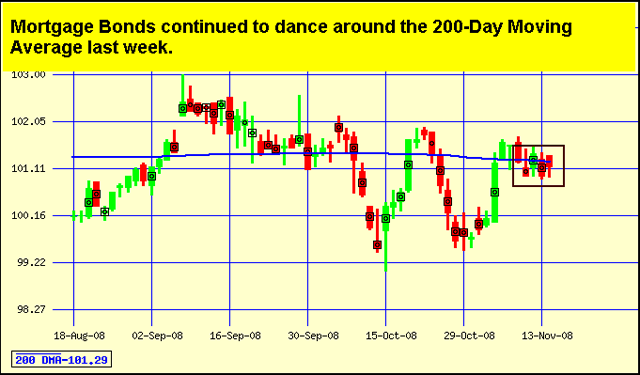
 However, despite all the bad economic news of the week, Bonds and home loan rates were unable to make significant improvements this week as they fought to defeat and move convincingly above a very important technical level called the 200-Day Moving Average. Read on, to understand more about the significance of this technical indicator.


LOSING A JOB IS ALWAYS A TOUGH EXPERIENCE, BUT IT PAYS TO FOLLOW GOOD ADVICE IF YOU OR SOMEONE YOU KNOW RUNS INTO THIS SITUATION. CHECK OUT THIS WEEK'S MORTGAGE MARKET VIEW FOR JOB SEARCH TIPS THAT CAN MAKE ALL THE DIFFERENCE IN TOUGH MARKETS.


        Forecast for the Week

        There are several important economic reports ahead this week...is more bad economic news on the way? Tuesday and Wednesday will be big days on the inflation front as Tuesday brings the wholesale measuring Producer Price Index while Wednesday's Consumer Price Index (CPI) report will show us inflation at the consumer level - that is, how much more expensive goods and services are for consumers this month over last month, as well as year over year. Given the Fed's recent rate cuts (which can trigger inflation), it will be important to see what these reports show.

 Wednesday will also bring a read on the new construction housing market with the Housing Starts and Building Permits Report, and Thursday is another important day to note as the Philadelphia Fed Report will be released. This monthly survey of manufacturing purchasing managers conducting business around the tri-state area of Pennsylvania, New Jersey, and Delaware is one of the most-watched manufacturing reports. Given both the poor Jobs and Retail Sales reports of late, this is likely to be somewhat negative as well. Weak economic news normally helps Bonds and home loan rates improve, as money flows out of Stocks and into Bonds, so I will be watching very closely for improvement during the coming week.

  However, to gain improvement, Bonds would have to convincingly defeat and move above a technical level called the 200-Day Moving Average. A moving average is the average closing price of a financial instrument over a given time period. In this case, the 200-Day Moving Average can act as a "ceiling of resistance", preventing Bond pricing from moving higher and helping home loan rates improve, or a "floor of support" that can keep Bond prices from moving lower and causing home loan rates to worsen.

 You can see in the chart below how Bonds danced around this level all last week, so I will be watching closely during the coming week to see if Bonds and home loan rates can breakthrough this resistance and move in an improving direction.

 Chart: Fannie Mae 6.0%% Mortgage Bond (Friday Nov 14, 2008)

 Japanese Candlestick

Chart<http://www.mmgweekly.com/templates/mmgweekly/reg_chart/168/images/

fnma11172008.gif>


        The Mortgage Market View...

Tips for Finding a Job in Tough Markets


Finding a job during tough economic times doesn't have to be tough...if you know which strategies work. Here are some tips for beating the odds:


Take Networking to the Next Level: Networking is always a great job strategy, but in the current economic climate, you need to go a step beyond letting your contacts know you are looking for a job, since many other people may be doing the same thing. Instead, develop a compelling business idea for your field or the field you would like to enter. Then, when you call or email your contacts, let them know you are researching your idea and would like to meet with industry insiders to discuss its viability. With this strategy, people will see you as someone with something to offer them, rather than as someone who needs something. And if the people you meet with like your idea, your meetings could lead to a job offer even though you never asked for a job.

Focus on Sectors That Are Hiring: No matter what industry your background is in, the skills or experience you possess may qualify you for a position in a new field. For instance, sales and customer relations are skills needed in a variety of industries. To begin, make a list of your experiences and skills that could help you find a job in a sector that is currently hiring. Then, gear your resume and cover letter to focus on these particular skills and experiences.

 Aim for Your Dream Job: Many job seekers begin to panic and apply for any job that's available. This is a mistake for several reasons. First, passion and enthusiasm are your best weapons for succeeding in your jobsearch. Employers can tell the difference between someone who really wants to work for them...and someone who will take any job. Second, when you are focused on finding a specific job versus any job, you make it easier for friends and colleagues to help you because they will have a clearer idea of who they could contact for you. Third, if you're in the middle of a job transition, why not use the opportunity to enter the profession you have always wanted to try?

  Be Creative About How You Start: During tough markets, many businesses are hesitant to add new employees and increase their level of fixed costs. You can offer to begin as an independent contractor for a period of time before receiving a review and possibly a future permanent job. This would give you a chance to earn an income while demonstrating your skills and value to the company. In turn, it lets the company evaluate your performance in a less costly way, because you would not receive benefits during this time; and with less risk for the company than having to make the decision to hire a permanent employee. You could also volunteer your way to a paid job. Many nonprofit organizations have powerful executives on their boards. By demonstrating your skills and work ethic as a volunteer, you could meet important connections that could lead to your next position.

The bottom line is this: Losing a job is tough during any market, but finding a job doesn't have to be tough when you are willing to be creative and use strategies that work!

Steve Papapietro

4300 El Camino Real

Suite 100

Los Altos, CA 94022

MetLife Home Loans is a division of MetLife Bank, N.A.

Monday, November 3, 2008

Steve Papapietro's Weekly Mortgage Bulletin: Fed Cuts Again

For the week of Nov 03, 2008 --- Vol. 6, Issue 45

        Last Week in Review

        "TAKE TIME TO DELIBERATE; BUT WHEN THE TIME FOR ACTION ARRIVES...STOP THINKING AND GO IN." Napoleon Bonaparte. And taking action after deliberating was exactly what the Fed did last week, when they cut the Fed Funds Rate by .50%, lowering it to 1.00%.

Why did the Fed take action last week, after it had already lowered the Fed Funds Rate by .50% on October 8 in a coordinated effort with other central banks? To continue to help ease the credit crisis, and prevent a long and severe global recession. In fact, several foreign central banks followed the Fed's lead again last week, with Hong Kong cutting their lending rate by .50%, Taiwan cutting by .25%, and Japan cutting by .20%. This is important because cuts by other nations help stabilize the US Dollar, which typically loses ground after our Fed cuts rates, because of the lower yield offered comparatively offered in the US. Another interesting point to note: since oil is Dollar denominated, the price per barrel typically jumps after our Fed cuts rates, because of the decline in the value of the Dollar. The cuts by other central banks should keep oil...and gas prices, in turn...from skyrocketing again.

Another reason the Fed took action: The Fed's statement discounted threats of inflation, saying that slowing economic growth should lower inflation pressures over time, but added that downside risks to economic growth remain. And last week's negative Gross Domestic Product reading is confirmation that things have slowed quite a bit. Although experts have speculated that the US may already be in a recession, the first hardcore signs appeared when the Third Quarter Advance GDP report showed that consumer spending declined at the fastest pace in 28 years. The report also reflected the largest quarterly decline since the end of the last recession in 2001.

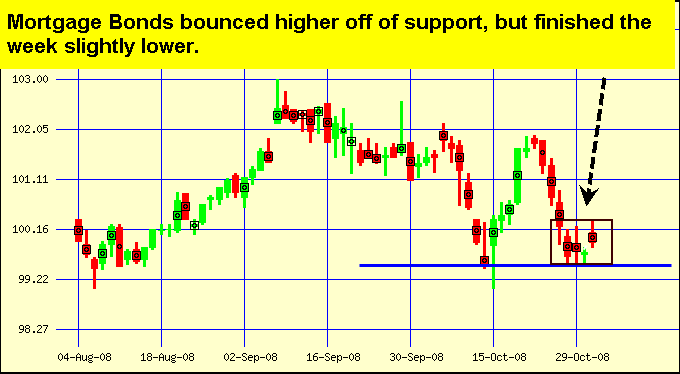
So what did all of this mean for Bonds and home loan rates last week? After worsening early in the week, Bonds and home loan rates attempted to stabilize by week end. And while it was a treat that Bonds did bounce off an important level of technical support, home loan rates still ended the week nearly .125-.25% worse than where they began.

SPECIAL NOTE: BRAND NEW VIDEO FEATURE IN THIS WEEK'S MORTGAGE MARKET VIEW! CHECK IT OUT TO LEARN SOME HOT TIPS TO CONSIDER WHEN BUYING OR LEASING YOUR NEXT VEHICLE.

        Forecast for the Week

        The excitement continues, as the heavyweight Jobs Report is scheduled for release this Friday, which will show the number of jobs lost or gained in October. Remember that the Department of Labor averages their numbers, and part of each month's report includes "revisions" to the several prior months' numbers. Last month, the Labor Department reported that 159,000 jobs were lost in September, which was worse than the 105,000 lost jobs that economists were expecting. As of last month's report, the US has lost 760,000 jobs so far in 2008. And the news for October is not expected to be any better.

A negative report could be bad news for Stocks and good news for Bonds and Home loan rates, as bad economic news typically causes money to flow from Stocks and into Bonds. But as has been noted in recent weeks, things are anything but typical at the moment. Bottom line: count on me to be watching closely to see how the markets react to this report and all the other news of the week...and feel free to call me anytime, even if you'd just like to do a quick review of your own current financial and credit situation.

As you can see in the chart below, Bonds did bounce off a key technical support level late in the week. I will let you know if Bonds can remain above this important support during the week ahead.

Chart: Fannie Mae 6.0%% Mortgage Bond (Friday Oct 31, 2008)

 Japanese Candlestick

Chart<http://www.mmgweekly.com/templates/mmgweekly/reg_chart/166/images/

fnma11308.gif>

        The Mortgage Market View...

        Click Here to view the latest Video.

<http://www.mmgweekly.com/w/index.html?SID=978362ce7b096266e2cefb878aa32

50b#view>

Should You Buy or Lease?

By Mark K. Solheim


To hear the critics wail, you'd think leasing a car is as bad for your finances as smoking cigarettes is for your health. Does that mean you're a closet wastrel if you've ever been tempted by ads that trumpet affordable monthly payments for a new car? Or, worse, that you are hurtling down the highway to financial ruin if you've already given in?

Relax. Leasing is not a mortal sin of money management. For some drivers, in fact, it makes sound fiscal sense. Leasing's not for everyone, but there's no reason to scorn the 15% of our fellow travelers who choose leasing over buying.

A Closer Look

Leasing often gets a bum rap because the lingo can make your head spin. It's difficult to compare one lease with another, not to mention to compare leasing with buying. And it can be tough to get a handle on leasing because the decision to lease or buy often depends on your mindset. "A lot of people are freaked out by having to turn in their car at the end of the lease," says Phil Reed, author of Edmunds.com's Strategies for Smart Car Buyers. "What they fail to realize is that they got the first years of a brand-new car's life."

One of the biggest criticisms of leasing is that in a buck-for-buck comparison of leasing and buying, leasers usually shell out more money. That's because, after the loan payments are done, buyers get to keep the vehicle (pay cash and you come out further ahead). If your modus operandi is to buy a car and run it till it sputters and dies, leasing isn't right for you. But you're a good candidate, Reed says, if you've decided that you're always going to have a car payment - as many drivers do, now that six- and even seven-year loans are gaining popularity. It's a good bet that you can drive more car for less money if you lease. You'll never actually own the car, but who really owns a car when the bank holds the title until the loan is paid off?

A few other advantages: A lease usually ends about the same time as the warranty, so you probably won't pay for any repairs. You won't have to worry about whether you'll get a fair deal on a trade-in. In most states, you pay sales tax only on the monthly payments rather than on the full value of the car. Plus, many of today's leases include gap insurance to cover the difference between the lease payoff and an insurance settlement if the car is totaled or stolen.

Yes, there are early-termination fees if you change your mind. But if you finance a car and bail out before the loan is paid off, you could easily owe more on the loan than the car is worth. And it's true that you pay extra for exceeding the 10,000- to 15,000-mile yearly limit typically written into a contract. But buyers who rack up high mileage also pay a penalty: lower trade-in value.

Design Your Own Lease

If you choose a manufacturer-subsidized lease, you'll probably be locked in to the terms. But if the car you want isn't being pushed by the carmaker, there's plenty of room for bargaining. Either way, contact several dealers to see who's willing to cut you the best deal. Reed of Edmunds.com recommends a term of three years because that's often the turning point in a car's life (when the warranty expires, for instance, o r you may need new tires).

Ask the dealer to compare leasing offers on the car from the manufacturer's financing arm as well as a few banks. That may produce a lower "money factor" (basically the interest rate) or higher residual, either of which translates into lower payments.

  Next, target the capitalized cost - leasing lingo for the price of the car written into the lease. Gross cap cost includes the price of the vehicle, fees, extended service plans, gap-insurance premiums and any other add-ons. Adjusted cap cost is the gross cap cost minus reductions for trade-in, down payment, and rebates. That adjusted cost is the amount you actually finance. Don't pay sticker unless you have to. Both Kelley Blue Book (www.kbb.com) and www.Edmunds.com list actual transaction prices to give you an idea of what others are paying.

If you expect to drive more than the number of miles included in the standard contract, try to negotiate a higher limit. Or you may be able to buy extra miles up front for an extra 10 or 15 cents per mile, versus the usual 15- to 30-cent-per-mile penalty charged at the end of the lease.

You usually have the option of buying the car at the end of the lease instead of turning it in. The purchase amount, typically the residual value, is written into the lease. Buying may not be a good idea, though, if the residual was set artificially high.

Not up for haggling? Kiplinger's has teamed with CarBargains, a buying service from the nonprofit Consumers' Checkbook organization. Its LeaseWise service will negotiate with five local dealers for you. The cost is $335. Visit www.kiplinger.com/links/carbargains or call 800-475-7283.

Reprinted with permission. All contents (c) 2007 The Kiplinger Washington Editors, Inc.

Steve Papapietro

4300 El Camino Real

Suite 100

Los Altos, CA 94022

Metlife Loans is a division of MetLife Bank, N.A.

Saturday, September 13, 2008

Steve Papapietro's Weekly Mortgage Bulletin: Weak Jobs May Provide Opportunity


Last Week in Review

"The best way to appreciate your job is to imagine yourself without one." Oscar Wilde. And for many Americans, job loss is not just something they're imagining--it's reality--as the Labor Department's August Jobs Report showed that the US economy has lost 605,000 jobs so far this year.

Last Friday's Jobs Report revealed several important pieces of information. In terms of job losses, the report showed that 84,000 jobs were lost in August and that the numbers for June and July were heavily revised, so that an additional 58,000 jobs were erased. But the real buzz came when the report showed that the Unemployment Rate swelled to 6.1% from 5.7%, which marks the highest Unemployment Rate since September 2003.

And since job losses are bad for the economy... and bad news typically causes money to flow from Stocks into Bonds... on Friday morning, Bonds and home loan rates initially built on the improvements they made earlier in the week. However, Stocks were able to rally later on Friday, and while Bonds and home loan rates gave back some of the improvements they made, they were still able to remain above an important floor of support at their 200-day Moving Average (a moving average is the average closing price of a financial instrument over a given period of time).

So despite the worsening trend for Bonds late day Friday, home loan rates still ended the week nearly .125 percent better than where they began.

Making Smart Spending Choices IS A Wise Thing To Do In Any Job Market! Check Out This Week's Mortgage Market View For Some Great Grocery Spending Tips!

Forecast for the Week

We will likely see another volatile day on Friday this week, with the delivery of two high impact reports with the potential to shake things up. Both set for release at 8:30AM ET, we will see the wholesale inflation measuring Producer Price index, as well as the Retail Sales Report. It will be important to see if the recent drop in oil prices has made an impact on either the cost to manufacture or if it has invigorated retail purchases due to the savings in the cost to fuel vehicles.

Inflation at any level remains a strong concern, so the Producer Price Index will be of high interest to many, including the Fed. On the Retail Sales Report, remember that a strong Report would be good for the Stock market--which stands to reason, as it would indicate continued consumer confidence and dollars being poured into the economy. But stronger economic news and higher stock prices will likely worsen Bonds and home loan rates. The aforementioned 200-day Moving Average, seen below in blue, is an important threshold in determining the direction of home loan rates in the coming weeks. A convincing move above this line would be good news for Bonds. Let's watch this closely, as it may represent some opportunities ahead. 

Remember when Bond prices move higher, home loan rates move lower... and vice versa. As you can see in the chart below, Bonds and home loan rates managed to stay above the 200-day Moving Average. I will be watching this closely to see if Bonds and home loan rates can remain above this important level.

The Mortgage Market View

Grocery Shopping Tips

With food prices still soaring, supermarkets are offering many deals and specials to lure in food shoppers. But sometimes, these good deals can actually cause people to spend more than they would have otherwise. Phil Lempert, author of Being the Shopper: Understanding the Buyer's Choice, offers these smart-shopping tips--

Limit Four Per Person: Scarcity can have a powerful impact on shoppers. A buying restriction can tempt people to buy more than they need, which could cause items to either spoil or sit in your pantry for a long time.
Tip: In the long run, when you factor in the amount of products that spoil or are eventually thrown away, you will usually be better off financially if you only buy the amount you reasonably need and can use.

End of Aisle or Freestanding Displays: Often the "specials" displayed on the end caps of each aisle or on an island display aren't really the best deals that the store currently offers. These displays may also lead to impulse buys that you weren't intending to make. For instance, a display with graham crackers, chocolate, and marshmallows could make you think "I'll make s'mores for dessert." Tip: While the location of these items is convenient, especially during busy shopping hours, you should only buy these items if they really are good deals.

Buy One, Get One Free: While these deals can make you feel like you are getting something for half price, if the cost is more than that of a similar item, or if you don't need a large quantity, than this may be one special worth passing up. Tip: Ask the manager if you can buy one item for half the price instead of buy one get one free. While stores don't always advertise this alternative, they often allow it.

Pre-Sliced Produce: While pre-sliced produce can feel like an easy choice, it can cost twice as much as whole produce, and can spoil faster than whole produce. Tip: Pay extra for prepared meals and produce only if the time and effort they save you is significant and really worth it.


Steve Papietro
Relationship Manager
MetLife Home Loans